Ask someone who has lived in Ossining for more than a few years what they do on a Saturday and you will hear the same three things in almost any order: the farmers market, a walk somewhere near the water, maybe lunch downtown after. Ask them how those three things connect and most people shrug. They picture getting back in the car between stops, because that is how most towns work. Ossining is different in a way that rarely comes up: the market, the walk, and the water are already joined by a path that has existed since 2016, and a surprising number of residents have never used it.
That path is the Sing Sing Kill Greenway, and it is the quiet hinge that turns three separate errands into one continuous loop through the middle of the village.
Where Saturday Actually Starts
The Down to Earth Ossining Farmers Market sets up every Saturday from 8:30 a.m. to 1 p.m. in the parking lot near the corner of Main and Spring Streets, running from early May through mid-December. The market itself is not new. It has anchored that corner of downtown for decades, and it is the kind of fixture that people plan mornings around without thinking much about what comes next. Most Saturday routines end here, or drift into whichever Main Street storefront is open. Very few continue on foot toward the river, because the obvious route looks like a drive.
It isn't one.
The Gorge With No Signage
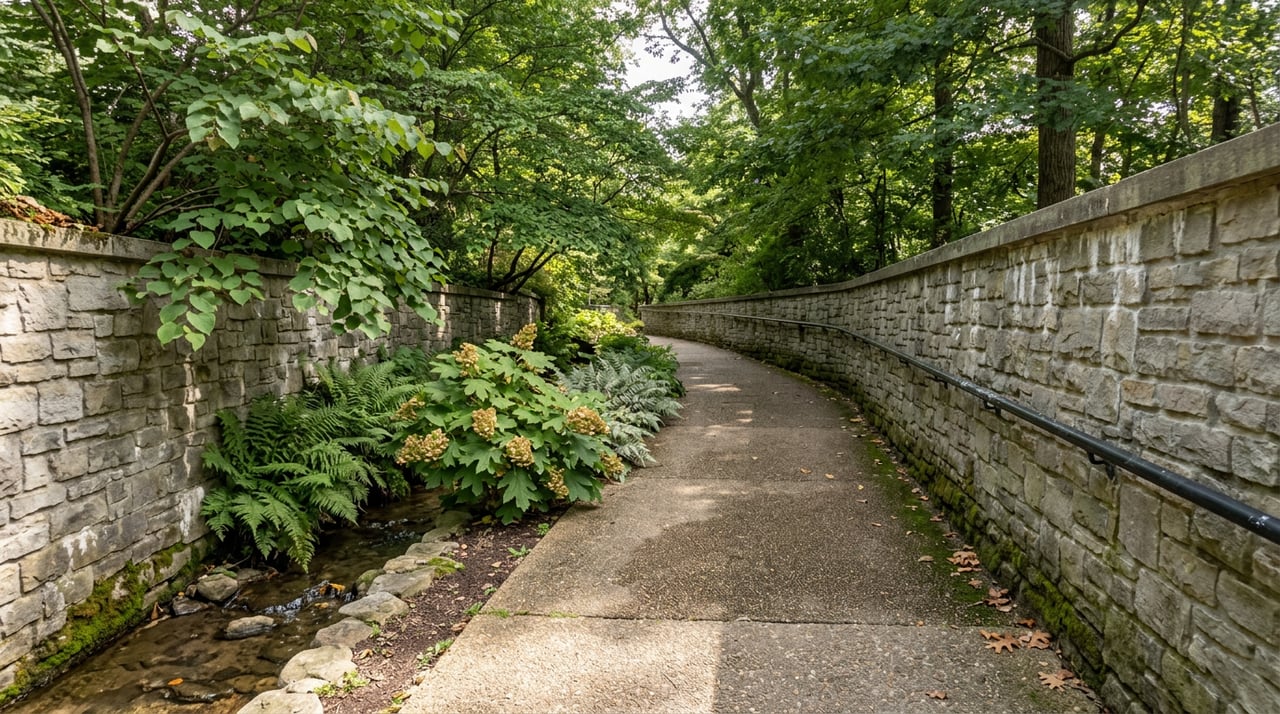
A short walk from Main Street sits the Joseph G. Caputo Community Center at 95 Broadway, and behind its lower parking lot, mostly unmarked, is the entrance to the Sing Sing Kill Greenway. People who have found it describe it almost apologetically: no real signage, no fee, nothing announcing that a rocky gorge sits a few steps off a municipal parking lot. You just walk through the lot and the ravine appears.
The walkway itself runs about a third of a mile, paved and lined with steel railings, following the Sing Sing Kill as it drops through a narrow gorge toward Central Avenue. It opened to the public in 2016 after the Village spent years working with state and federal partners to convert what had been an inaccessible industrial ravine into a walkable greenway. Overhead, the Double Arch Bridge carries the route of the historic Old Croton Aqueduct across the gorge, close enough that you can stand on the walkway and look straight up at 19th-century stone construction still doing its job over a stream most of downtown Ossining walks past without noticing.
A few practical points, since the trail rewards knowing them ahead of time:
- The walkway is ADA-accessible only from the Community Center side. The Central Avenue end requires stairs.
- Leashed dogs are welcome, though the path is narrow enough that courtesy matters.
- The gorge is more dramatic after rain, when the kill is actually running. In dry stretches it can feel like a quiet stone corridor rather than a waterway.
None of this is hidden intentionally. It's just underused, tucked between two more famous features of downtown, easy to walk past for years without trying.
What the Kill Used to Power
The stream itself has been doing real work in this town since long before anyone thought to build a walkway next to it. Starting in the 18th century, the Sing Sing Kill's current drove gristmills and sawmills that helped establish Ossining as a working village, not just a river landing. By the 19th century, the same stream was supplying water to Sing Sing Prison itself, tying the gorge directly to the institution that gave the village its name and its most complicated legacy. Even the name carries that history forward: "kill" comes from the Dutch word for stream, a leftover from the region's colonial roots that still shows up in Hudson Valley place names today.
Walking the greenway is not just a shortcut to the river. It is a walk through the actual infrastructure that built the place, still visible instead of buried under a parking lot, which is what happened to most urban streams of its size.
Where the Path Lets You Out
The greenway ends at Central Avenue, where the kill continues on toward Water Street and eventually the Hudson. From there, the walk to the riverfront is short and flat, none of the elevation change you just descended through the gorge. This is the part of the loop that most people already know, even if they have never connected it to the market or the greenway: Louis Engel Waterfront Park, with its old guard tower still standing as a physical reminder of the prison's presence on the river, and the newer Henry Gourdine Waterfront Park, which added eight interpretive panels tracing the riverfront's story back to the Sint Sinck people who lived along the Hudson long before European settlement.
The Village's own planning materials describe the connection between the greenway and this stretch of waterfront as still being finished as part of a larger DPW site redevelopment, which explains why the transition from gorge to river feels a little more improvised than the rest of the walk. It works today. It is meant to work better.
Lunch Without Backtracking
If the loop ends at the water, it makes sense that lunch does too. Harbor Square, right next to the Metro-North station and the NY Waterway terminal, is home to 3 Westerly Bar and Grill, built inside a free-standing lighthouse structure that makes it hard to miss once you're standing at the river's edge. It is the obvious stop if the goal is a table with a view, and plenty of Saturday walkers treat it as the finish line.
But the loop back toward Main Street offers just as much reason to stay downtown. Melike Turkish Cuisine serves a straightforward Mediterranean menu built around lamb kebabs, chicken shish, and falafel, with meze plates like hummus and stuffed grape leaves that work well for sharing after a walk. Richie's Kitchen leans into Dominican, Puerto Rican, and Cuban flavors, and its Mofonguito Trio, three small plantain cups filled with beef, chicken, and shrimp, is built exactly for someone who wants to taste more than one thing after a morning of walking. Cravin adds another Caribbean option a few doors down, rounding out a stretch of Main Street that covers more culinary ground than its size suggests.
None of these require a second car trip. They sit within the same footprint as the market, the greenway, and the river, which is the entire point.
The Loop Nobody Names as a Loop
What makes this worth writing down is not any single stop. The market is well known. The waterfront is well known. Even the greenway, once you've walked it, feels obvious in hindsight. What's easy to miss is that these are not three separate destinations requiring three separate decisions about whether a Saturday is worth the effort. They are connected, on foot, through a stretch of downtown most people have already driven past a hundred times without registering.
Ossining's downtown was built in layers, an old mill stream, an aqueduct crossing, a prison, a village square, and it still carries all of them at once. The greenway is just the one piece that requires you to look down instead of across the street to notice it's there.
If you've lived here a while and haven't walked the gorge, this is the season for it. The kill runs higher after a good rain, the market calendar still has months left before its December close, and the walk from Main Street to the river takes less time than most people assume once they stop treating it as three separate trips.
For more on what makes life in Ossining and the surrounding river towns worth paying attention to, Blanchet Team keeps a close eye on the neighborhoods we work in, not just the listings in them. If a move to this stretch of the Hudson is ever on your mind, we're happy to talk through what that actually looks like.